+91 7297051181
Delhi HC Grants Interim Relief to Goethe-Institut, Restrains Use of 'Max Mueller' Mark
In a significant trademark ruling, the Delhi High Court has granted interim relief to Goethe-Institut, restraining a competing entity from using the marks ‘Max Mueller’ and ‘Max Mueller Institute’. The Court recognized Goethe-Institut's prior use and reputation in India, citing deceptive similarity, passing off, and Section 34 of the Trade Marks Act, 1999. The decision reinforces the protection of established brand identity and highlights the Indian judiciary’s firm stance against misuse of goodwill.
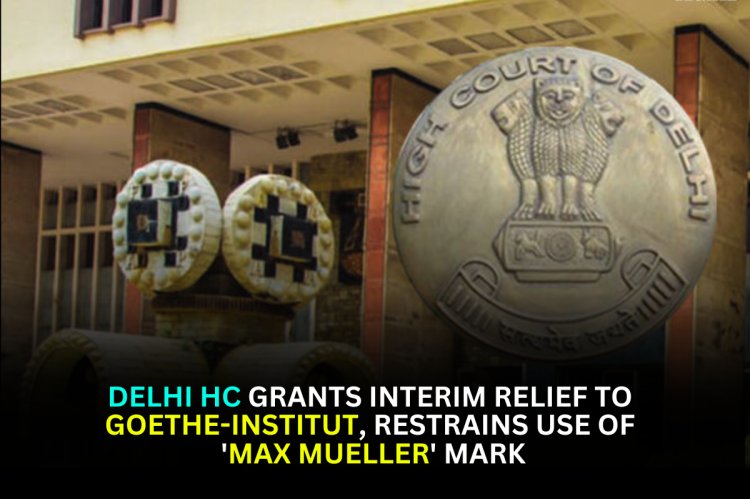
In a notable decision reinforcing the strength of prior use and brand recognition in trademark cases under Indian law, the Delhi High Court has issued an interim injunction in favour of Goethe-Institut E.V., effectively restraining the defendants from using the trademarks ‘MAX MUELLER’ and ‘MAX MUELLER INSTITUTE’ for the time being.
The case — Goethe-Institut E.V. v. Abhishek Yadav & Another (Neutral Citation: 2025:DHC:3337) — was presided over by Justice Mini Pushkarna. The Court found that Goethe-Institut had made a prima facie case based on early adoption, brand recognition, and substantial documentation proving its reputation in India.
Background and Dispute:
Goethe-Institut, an internationally reputed cultural institution registered in Germany, has operated in India since 1957 under the banner Max Mueller Bhavan, providing German language training and cultural programs. The defendants, meanwhile, began using the labels MAX MUELLER and MAX MUELLER INSTITUTE for similar educational services, and also registered related domain names, such as www.maxmuellerinstitute.com and www.maxmuellerinstitute.in.
Goethe-Institut argued that these marks were deceptively similar and intended to mislead the public into thinking there was a connection with its long-established institution. The defendants claimed that they used the name in homage to Max Müller, a renowned German Indologist, asserting their intentions were genuine.
Plaintiff’s Core Arguments :
- Offering Identical Services:
The defendants offer German language education—just like the plaintiff. Despite claiming usage for over 15 years, their trademark filings show "proposed to be used", suggesting no substantial past usage has been proven. - Course Structure Mimicked:
The defendants’ site offers six levels of language courses, replicating Goethe-Institut’s own structure, indicating imitation. - Misleading Association:
The defendants appear to intentionally create a false impression of affiliation with the plaintiff, aiming to benefit from its established credibility. - Online Confusion:
Online searches for "MAX MUELLER" often show the plaintiff’s results first, followed by the defendants’ site. This can easily mislead users into thinking the two entities are related, especially when course descriptions are copied. - Deliberate Deception for Gain:
The entire branding strategy of the defendants seems designed to confuse customers and capitalize on Goethe-Institut’s goodwill. - Informed Misuse:
The name MAX MUELLER has long been associated with the plaintiff. The defendants, despite knowing this, have adopted it for commercial use.
To know more about this you can follow the link below:
<iframe width="560" height="315" src="https://www.youtube.com/embed/OSjRQxvH2SU?si=tHt59nsvYILqT15b" title="YouTube video player" frameborder="0" allow="accelerometer; autoplay; clipboard-write; encrypted-media; gyroscope; picture-in-picture; web-share" referrerpolicy="strict-origin-when-cross-origin" allowfullscreen></iframe>
Judicial Reasoning:
The Court dismissed the defence that the name was a generic tribute. Instead, it recognized that:
- The name Max Mueller Bhavan had, over time, become a unique identifier for Goethe-Institut’s educational offerings.
- Section 34 of the Trade Marks Act, 1999 protects the rights of a prior user even if another party registers the same or similar mark later.
- The similarity in domain names and course offerings posed a serious risk of public deception.
- Evidence such as PAN cards and bank documentation further demonstrated that the name was tied to the plaintiff’s operations in India.
- The defendants' filings marked the trademark as “proposed to be used”, which undercut their own claim of long-term usage.
In bolstering its ruling, the Court relied on key Supreme Court precedents including Laxmikant V. Patel v. Chetanbhai Shah (2002) and S. Syed Mohideen v. P. Sulochana Bai (2016), reaffirming the principle that earlier users have stronger rights, and that leveraging someone else’s brand value amounts to passing off.
Key Observations:
Justice Pushkarna highlighted the real potential for confusion:
“An average man with imperfect memory… may easily mistake the defendants’ website as part of the plaintiff’s network.”
She further observed:
“The defendants’ adoption of the impugned marks is clearly dishonest. No amount of usage can justify or cure this tainted adoption.”
Conclusion:
This interim order by the Delhi High Court is a strong reminder of the Indian judiciary’s stance on protecting established reputations and curbing unfair market practices. By halting the usage of ‘MAX MUELLER’ and related marks by the defendants during the lawsuit, the Court has upheld the sanctity of prior user rights and safeguarded the distinctiveness of cultural and educational brands from misrepresentation and brand dilution.